Why the Next Decade Will Create Very Different Outcomes for Divorce Professionals
For years, success in the divorce industry was driven primarily by expertise, reputation, and referrals.
Those factors still matter.
But they are no longer enough.
A major shift is underway across the divorce services landscape, and it is affecting attorneys, attorney-mediators, mediators, legal document professionals, divorce coaches, and other family law professionals alike.
The divide is not between litigation and mediation.
It is not between lawyers and non-lawyers.
It is not even between large firms and solo practitioners.
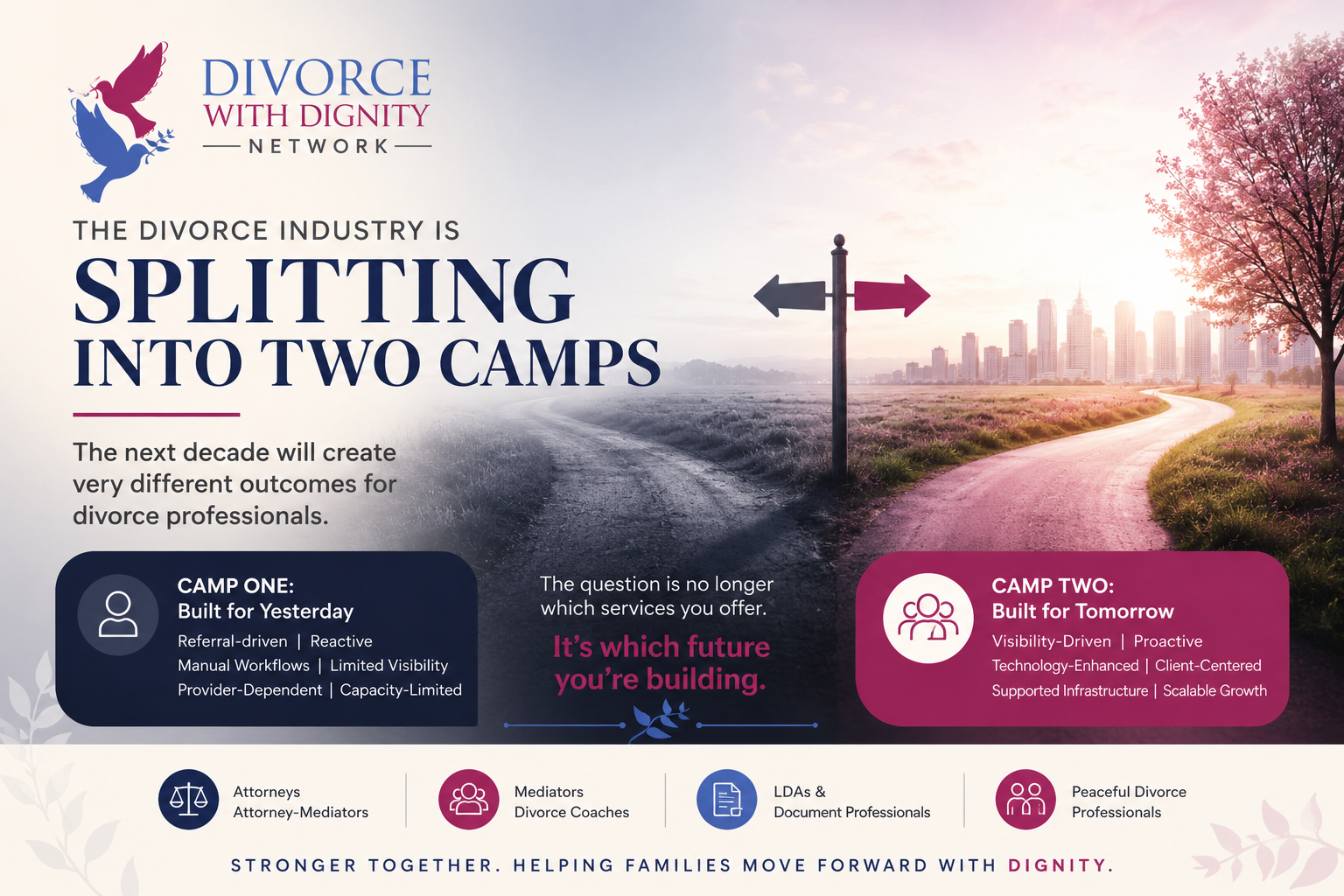
The real divide is emerging between practices built for the future and practices built for the past.
And that distinction may determine which professionals thrive over the next decade.
The Divorce Consumer Has Changed
Today’s divorce clients behave differently than they did even five years ago.
Before contacting a professional, many consumers now:
- Research options online
- Read reviews
- Compare service models
- Watch educational videos
- Ask AI platforms questions
- Explore alternatives to litigation
- Look for transparent pricing and process information
Many clients have already formed opinions before the first consultation is ever scheduled.
This shift means that expertise alone is no longer enough to create growth.
Visibility matters.
Education matters.
Accessibility matters.
Client experience matters.
The professionals who recognize these changes are adapting accordingly.
Two Types of Divorce Practices Are Emerging
Camp One: Traditional Practice Models
These practices often rely heavily on:
- Personal referrals
- Manual workflows
- Individual provider capacity
- Limited online visibility
- Reactive business development
- Provider-dependent growth
Many of these professionals are highly skilled.
The challenge is not competence.
The challenge is infrastructure.
When growth depends entirely on the provider’s time, energy, and availability, scalability becomes difficult.
Camp Two: Modern Practice Models
These practices are increasingly built around:
- Strong digital visibility
- Structured client journeys
- Technology-enabled workflows
- Educational content
- Operational systems
- Collaborative support
- Consistent lead generation
- Scalable business infrastructure
These professionals are not necessarily working harder.
In many cases, they are working differently.
Their practices are designed to support sustainable growth rather than constant operational maintenance.
The AI Question Every Divorce Professional Should Be Asking
Artificial intelligence is already changing consumer behavior.
Potential clients are now asking AI platforms questions such as:
- How does mediation work?
- Do I need an attorney?
- How much does divorce cost?
- What are my options?
- How do I protect my children during divorce?
This raises an important question.
If AI can explain divorce processes more effectively than a website, what becomes the true value of the professional?
The answer is not information.
Information is becoming increasingly available.
The value of divorce professionals is shifting toward:
- Judgment
- Strategy
- Conflict resolution
- Human guidance
- Problem-solving
- Relationship management
- Customized solutions
The future belongs to professionals who combine expertise with modern delivery systems.
Why Collaboration Is Becoming a Competitive Advantage
Historically, many divorce professionals operated independently.
Today, the demands of running a successful practice continue to expand.
Professionals are expected to manage:
- Marketing
- Technology
- Intake systems
- Client communication
- Content creation
- Search visibility
- Business operations
- Service delivery
At the same time, clients expect faster responses, greater transparency, and more organized experiences.
This is one reason collaborative business models are gaining traction across the industry.
Increasingly, successful professionals are leveraging networks, shared infrastructure, operational support, and strategic partnerships to strengthen their practices without sacrificing independence.
The Growing Importance of Visibility
One of the biggest misconceptions in the divorce industry is that competition is the primary challenge.
In reality, invisibility may be the larger threat.
Millions of consumers still do not understand the full range of peaceful divorce options available to them.
Many people remain unaware of:
- Divorce mediation
- Attorney-mediator services
- Legal document assistance
- Unbundled legal services
- Divorce coaching
- Collaborative support models
- Flat-fee divorce solutions
Professionals who effectively educate consumers often gain a significant advantage.
Visibility is no longer a marketing activity.
It is becoming a core business function.
The Future Is Not About Working Harder
For decades, many divorce professionals built successful careers through personal effort and professional excellence.
Those qualities remain essential.
But the next decade will likely reward something additional:
Business infrastructure.
The practices that thrive will increasingly combine:
- Professional expertise
- Modern systems
- Strong visibility
- Operational support
- Technology integration
- Exceptional client experiences
The goal is not to replace the human element.
The goal is to strengthen it.
What We Are Seeing Across the Industry
At Divorce With Dignity Network, we work with attorneys, mediators, attorney-mediators, legal document professionals, and other peaceful divorce providers across multiple states.
We are also actively collaborating with leaders throughout the dispute resolution and divorce services community, including our ongoing relationship with Mediate.com and others who are helping shape the future of conflict resolution and family transition services.
One trend is becoming increasingly clear:
The professionals gaining momentum are not necessarily the most experienced.
They are often the professionals who have aligned expertise with infrastructure.
They have recognized that the future of divorce services requires both.
Five Questions Every Divorce Professional Should Be Asking
- If referrals slowed down tomorrow, where would new clients come from?
- Is my practice visible where today’s consumers are searching for solutions?
- If I wanted to double my caseload, could my current systems support it?
- Am I using technology strategically or simply reacting to industry changes?
- Is my practice built for the next decade of divorce services?
The answers to those questions may determine which side of the industry divide a practice ultimately lands on.
Frequently Asked Questions
What is changing in the divorce services industry?
Consumer expectations, technology, AI, online research behavior, and demand for efficient service delivery are all reshaping how divorce professionals attract and serve clients.
Are referrals still important for divorce professionals?
Yes. Referrals remain valuable, but many successful practices now combine referrals with digital visibility, educational content, and structured marketing systems.
Will AI replace divorce professionals?
No. AI can provide information, but it cannot replace human judgment, conflict resolution skills, negotiation expertise, emotional intelligence, or customized legal and mediation guidance.
What types of professionals are adapting to these changes?
Attorneys, mediators, attorney-mediators, legal document assistants, divorce coaches, and other family law professionals are increasingly adopting modern practice models.
Why are collaborative networks becoming more important?
Networks can provide visibility, operational support, shared resources, technology infrastructure, marketing guidance, and professional community while allowing providers to maintain independent practices.
How can divorce professionals prepare for the future?
By strengthening visibility, improving client experience, adopting technology strategically, building operational systems, and aligning with supportive professional communities that help them scale sustainably.
Ready to Build a Practice for the Future?
If you’re a divorce professional who wants to strengthen your visibility, streamline operations, attract more qualified clients, and position your practice for long-term growth, now is the time to explore what’s possible.
Learn how Divorce With Dignity Network helps attorneys, mediators, attorney-mediators, and other peaceful divorce professionals build modern, sustainable practices:
👉 https://peacefuldivorcebusiness.com/get-started/
Schedule a conversation and discover how the right infrastructure, support, and strategy can help you thrive in the next decade of divorce services.